
You know the feeling: your body is sitting there, but your mind is racing. You need to buy milk, there’s an email you haven’t answered, an appointment to reschedule, and that underlying worry you won’t name. It’s not work—it’s the constant management of work. Researchers call it “mental load,” and it has one cruel characteristic: ordinary rest doesn’t clear it away.
Why the Couch Isn't Enough
Because scrolling isn’t resting—it’s continuing to process information, simply by switching topics every eight seconds. The brain stays in reactive mode—notifications, tiny decisions, comparisons—exactly the mode that caused the overload. We go to bed “rested” and wake up just as overwhelmed as before.
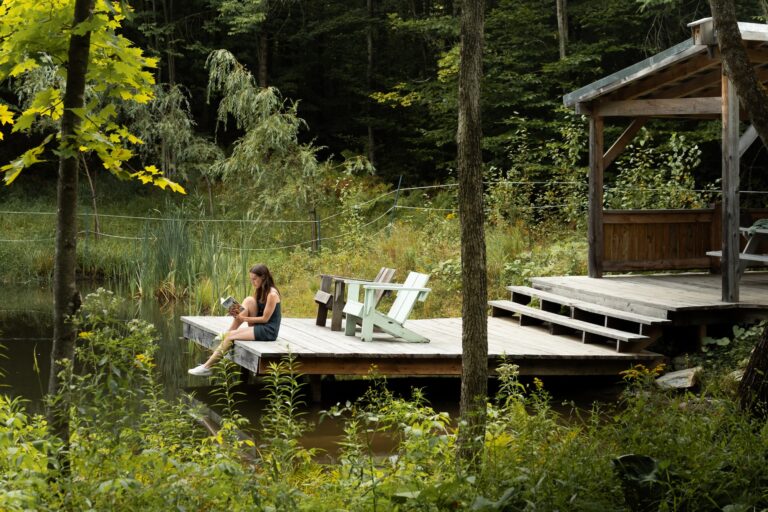
According to research on attention restoration, what reduces mental load is an environment that demands nothing: no decisions, no alerts, no opportunity to be productive. The forest checks all those boxes, and that’s one of the reasons we’ve deliberately kept our off-grid units at Station Chêne Rouge in North Hatley.
The “nothing to manage” effect
A stay with us takes the decisions off your hands, one by one: no cleaning to do, no firewood to find (it’s provided), no itinerary to plan (the trails start right at your door), no need to make restaurant reservations (your BBQ and campfire do the job just fine). What’s left is a day that’s almost empty—and that’s exactly the remedy. Many guests tell us that by the second morning, they’ve “forgotten what day it is.” That’s a sign of recovery. The guided version of this letting go is the art of doing nothing.
Three Steps to Speed Up Draining
Writing things down: When you arrive, write down everything that’s going through your mind on a piece of paper. Fold it up. When you open it again as you set out, half of it will no longer feel urgent. Just one decision a day: Which trail should I take this morning? The rest will follow. The closing ritual: Every evening by the fire, ask yourself aloud, “What was beautiful today?” It gently resets your radar. And if you want to understand why the fire helps so much, we’ve written about the science of the campfire. Just 1 hour and 30 minutes from Montreal, at Station Chêne Rouge in North Hatley: 4.9 out of 5 based on over 1,200 reviews.
The invisible work of management: planning, remembering, anticipating. It’s exhausting even when the body is at rest, because it constantly demands our attention.
At home, everything reminds you of a chore. In the forest, the environment asks nothing of you, and your mind—finally free—recharges on its own.
Guests describe how they really start to relax around the second day. That's one of the reasons for staying 2 or 3 nights.
Everything is arranged to take the hassle out of logistics: bedding, housekeeping, and firewood, depending on the package you choose. You arrive, and we take care of the rest.